Product update
ReWind RePower: find the optimal repowering year
ReWind RePower: find the optimal repowering year

We are living through one of the largest energy buildouts in history, driven by industry electrification, data centres and the low-emissions transition. Around $2.2 trillion is expected to be invested in clean technologies including renewables, nuclear, grids, storage, efficiency and electrification in 2026 (IEA 2026).
At the same time, Europe’s wind fleet is ageing. More than 57 GW of European onshore wind capacity is expected to have been operating for over 20 years by 2030. The potential from repowering these sites is significant: WindEurope data shows that repowering reduces the number of turbines by around 25% on average, while more than tripling the energy output of the wind farm.
For wind farm owners and operators, the question is therefore often not only whether to repower, but when. At what point does extending the life of the existing asset create less value than transitioning to a new wind farm?
Model the full transition to a repowered wind farm
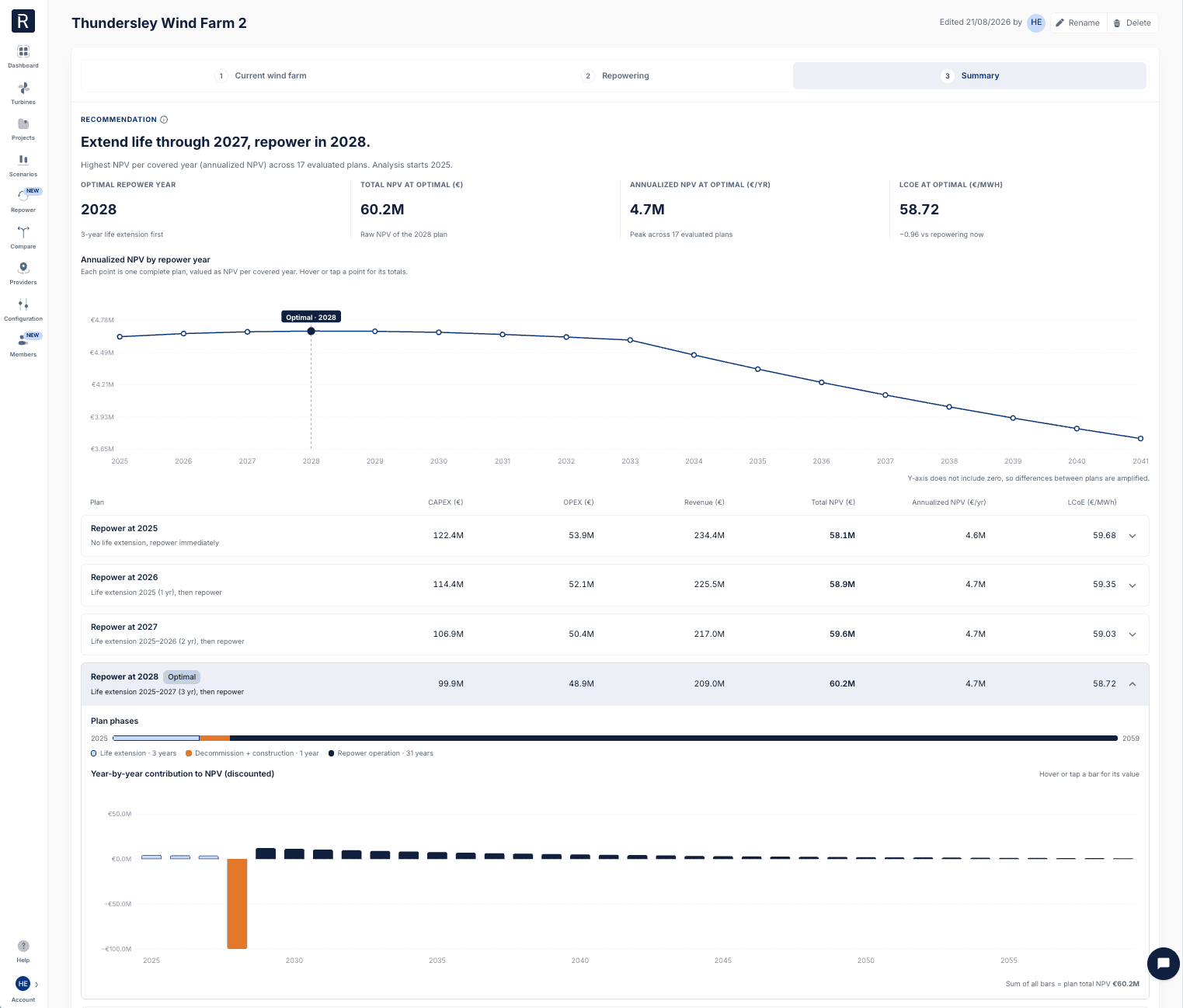
ReWind RePower models the full transition from the existing wind farm to a repowered project, including revenue and OPEX during life extension, decommissioning, CAPEX, construction time and the economics of the new wind farm.
RePower evaluates different repowering years as complete investment plans, calculating NPV, CAPEX and OPEX for each scenario. This makes it possible to compare the economics of different timings and identify the repowering year that maximises annualised NPV under the modelled assumptions.
Bottom-up OPEX modelling for life extension
The value of extending a wind farm depends in part on how its operating costs develop as the assets age.
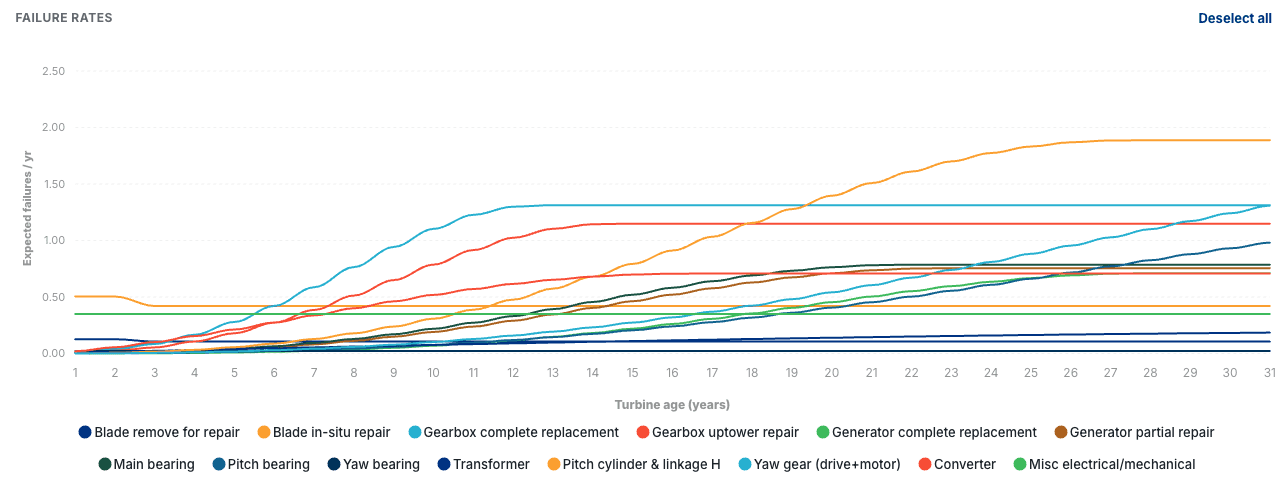
RePower models OPEX using individual component failure modes and allows users to adjust these assumptions using their own project data. CAPEX for the repowered project is benchmarked using turbine market data and country-level cost assumptions.
The analysis also accounts for the decommissioning and construction period between the existing and repowered wind farms, including the impact of lost revenue while the site is not producing electricity.
Interested? Get in touch!
RePower is currently in beta. If you are evaluating repowering or life-extension decisions across your fleet and are interested in taking part, get in touch with the ReWind team at hello@rewind-energy.com.
We are living through one of the largest energy buildouts in history, driven by industry electrification, data centres and the low-emissions transition. Around $2.2 trillion is expected to be invested in clean technologies including renewables, nuclear, grids, storage, efficiency and electrification in 2026 (IEA 2026).
At the same time, Europe’s wind fleet is ageing. More than 57 GW of European onshore wind capacity is expected to have been operating for over 20 years by 2030. The potential from repowering these sites is significant: WindEurope data shows that repowering reduces the number of turbines by around 25% on average, while more than tripling the energy output of the wind farm.
For wind farm owners and operators, the question is therefore often not only whether to repower, but when. At what point does extending the life of the existing asset create less value than transitioning to a new wind farm?
Model the full transition to a repowered wind farm
ReWind RePower models the full transition from the existing wind farm to a repowered project, including revenue and OPEX during life extension, decommissioning, CAPEX, construction time and the economics of the new wind farm.
RePower evaluates different repowering years as complete investment plans, calculating NPV, CAPEX and OPEX for each scenario. This makes it possible to compare the economics of different timings and identify the repowering year that maximises annualised NPV under the modelled assumptions.
Bottom-up OPEX modelling for life extension
The value of extending a wind farm depends in part on how its operating costs develop as the assets age.
RePower models OPEX using individual component failure modes and allows users to adjust these assumptions using their own project data. CAPEX for the repowered project is benchmarked using turbine market data and country-level cost assumptions.
The analysis also accounts for the decommissioning and construction period between the existing and repowered wind farms, including the impact of lost revenue while the site is not producing electricity.
Interested? Get in touch!
RePower is currently in beta. If you are evaluating repowering or life-extension decisions across your fleet and are interested in taking part, get in touch with the ReWind team at hello@rewind-energy.com.

ReWind AS © 2026. All rights reserved.
Torggata 11, 0181 Oslo, Norway
ReWind AS © 2026. All rights reserved.
Torggata 11, 0181 Oslo, Norway