Product update
Residual Value & Seasons
Residual Value & Seasons

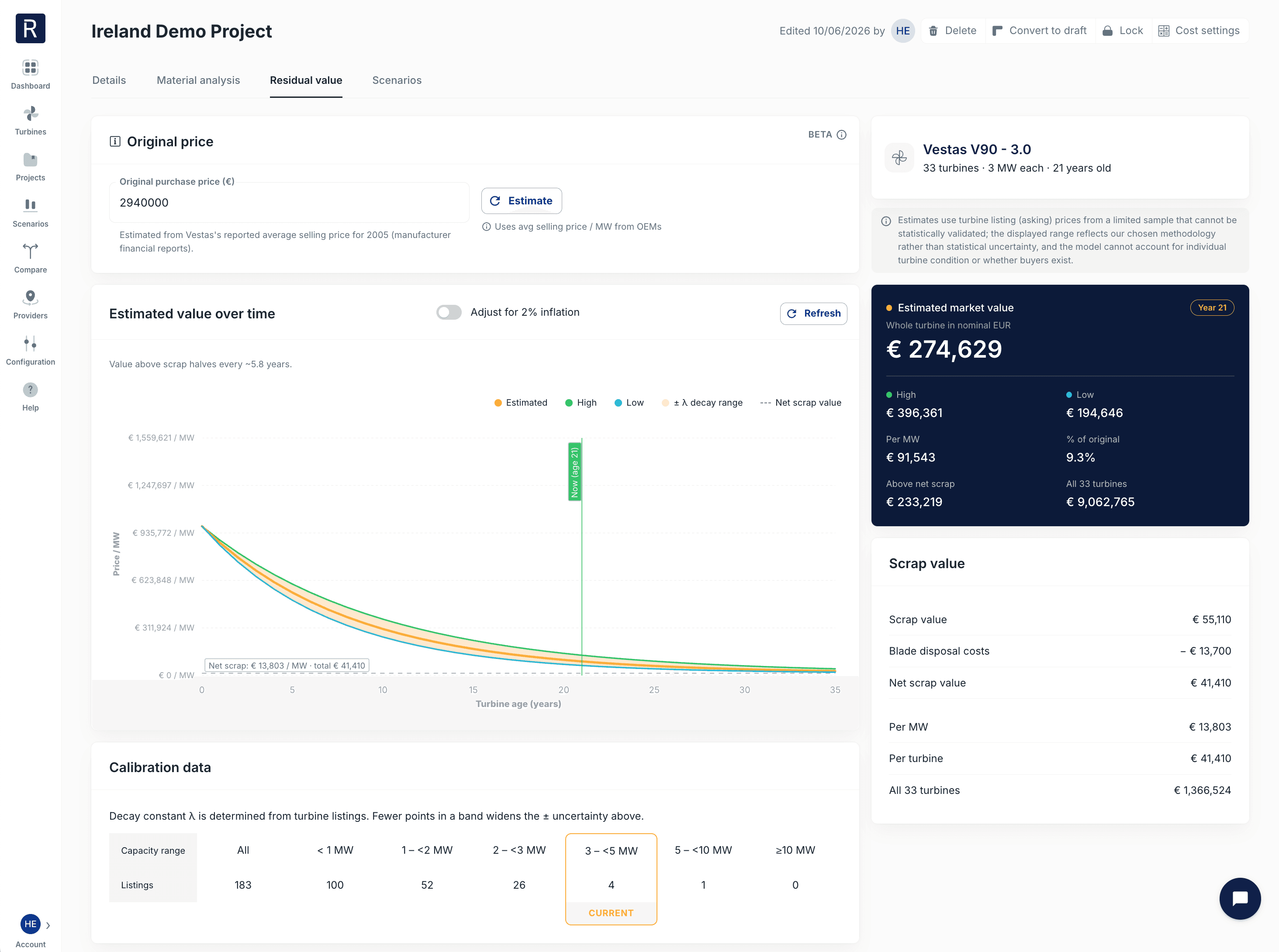
Residual Value
A growing market for 2nd hand turbines and components within the wind industry is emerging, as an increasing number of wind farms are reaching end-of-life. Selling old turbines and components can be an effective way of offsetting decommissioning costs and increasing project value.
With ReWind, you can now estimate the re-sale value (remaining market value) of your turbines, and compare this to the scrap value of the turbines. This can be an important input factor into your end-of-life decision on what year to sell the turbines, and this is also useful when determining the value of your assets and portfolio for financial planning, transactions, bonds and sureties.
Residual value is currently only available for onshore projects.
Offshore Season Support for floating
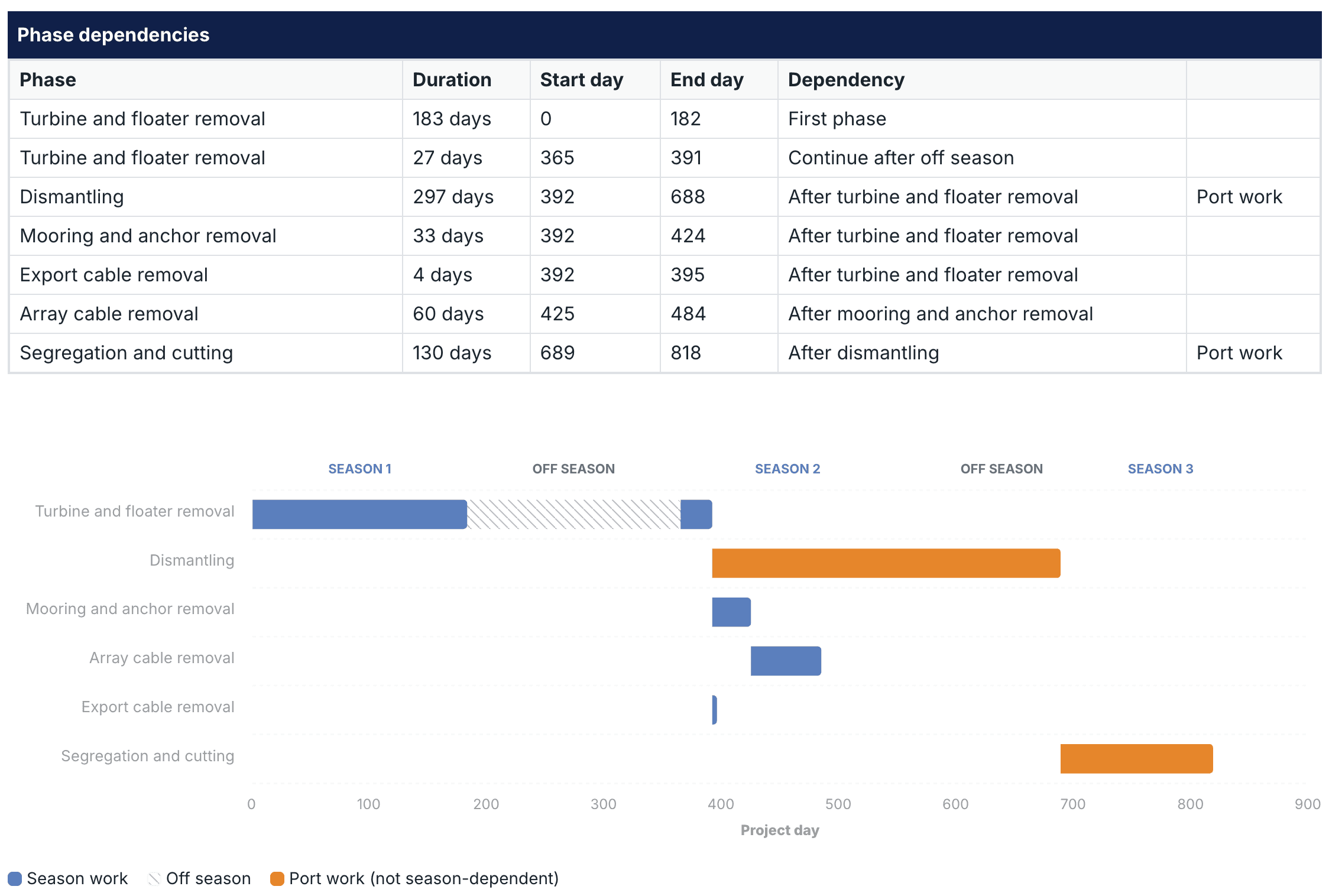
The decommissioning of floating projects rarely fits inside a single year’s offshore weather window. Work often spans several seasons and every extra season means another mobilization and demobilization cycle, which is one of the biggest cost drivers.
ReWind now models how each phase runs across seasons and adds the mobilization, demobilization and overhead costs accordingly. A few things you get:
Configurable season length
Phase dependencies respected. Phases that can run in parallel do, port work like dismantling and segregation stays season independent.
Seasons in the cost table. See how many seasons each project takes and what that adds.
Gantt chart showing Work, Idle and Off season, so you can see at a glance where the time goes.
Residual Value
A growing market for 2nd hand turbines and components within the wind industry is emerging, as an increasing number of wind farms are reaching end-of-life. Selling old turbines and components can be an effective way of offsetting decommissioning costs and increasing project value.
With ReWind, you can now estimate the re-sale value (remaining market value) of your turbines, and compare this to the scrap value of the turbines. This can be an important input factor into your end-of-life decision on what year to sell the turbines, and this is also useful when determining the value of your assets and portfolio for financial planning, transactions, bonds and sureties.
Residual value is currently only available for onshore projects.
Offshore Season Support for floating
The decommissioning of floating projects rarely fits inside a single year’s offshore weather window. Work often spans several seasons and every extra season means another mobilization and demobilization cycle, which is one of the biggest cost drivers.
ReWind now models how each phase runs across seasons and adds the mobilization, demobilization and overhead costs accordingly. A few things you get:
Configurable season length
Phase dependencies respected. Phases that can run in parallel do, port work like dismantling and segregation stays season independent.
Seasons in the cost table. See how many seasons each project takes and what that adds.
Gantt chart showing Work, Idle and Off season, so you can see at a glance where the time goes.

ReWind AS © 2026. All rights reserved.
Torggata 11, 0181 Oslo, Norway
ReWind AS © 2026. All rights reserved.
Torggata 11, 0181 Oslo, Norway